

Exciting VDC Department Changes
May 28, 2026
Rudolph and Sletten’s Virtual Design and Construction (VDC) Department has made meaningful improvements to better define and communicate the inner workings of building information modeling and virtual design within the construction industry. These efforts include clearly communicating VDC’s capabilities, technology platforms, and the R&S team members responsible for delivering these services.
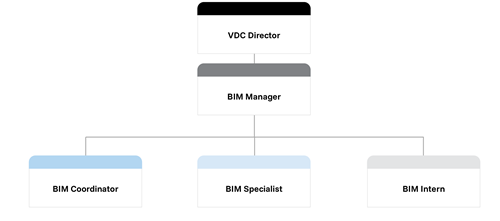
VDC’s first formal organizational chart was created to help internal teams and external project partners better understand the department’s structure and roles. The chart identifies VDC team members, their roles, and how those roles support a project from pursuit through closeout.
The department also clarified roles by developing a detailed breakdown of responsibilities. This provides project teams with a clearer understanding of what support to expect, who to engage, and how VDC resources are applied throughout the life cycle of a project, as outlined below:
- BIM Specialists are the technical production backbone of the VDC department, converting project needs into usable digital deliverables. Their responsibilities include model setup, clash detection, viewpoint creation, CAD background development, reality capture support, Cupix implementation, field support, and training. They play a critical role in advancing VDC efforts from concept to execution by producing the model-based tools, visuals, and coordination content relied upon throughout project delivery.
- BIM Coordinators help translate VDC standards into consistent project execution. They oversee model quality, digital document control, clash review, scope gap identification, coordination workflows, and platform organization across tools such as ACC and Revizto. By maintaining accurate, aligned, and current digital project environments, BIM Coordinators serve as a key link between production efforts and project-level implementation, enabling teams to coordinate more effectively and work from a shared source of truth.
- BIM Managers lead the strategy, structure, and implementation of BIM throughout a project’s life cycle. Their responsibilities include client engagement, pursuit support, BIM planning, schedule development, standards creation, execution documentation, task delegation, closeout oversight, and team performance management. By aligning VDC efforts with project goals, contractual requirements, and delivery strategies, BIM Managers ensure BIM is not just used, but used intentionally to support improved coordination, communication, and project outcomes.
Together, these roles create a coordinated VDC structure that supports projects from planning through execution. This structure helps ensure VDC is both strategically aligned and operationally effective across all phases of a project.
This added clarity has helped teams better understand how and when to engage VDC throughout a project. Internally, it improves understanding of how VDC contributes to project delivery and clarifies roles and responsibilities. Externally, it enables project teams and partners to engage VDC more effectively by aligning services with project needs earlier and more intentionally.