Building a New Center for Learning at Southwestern College
April 27, 2026
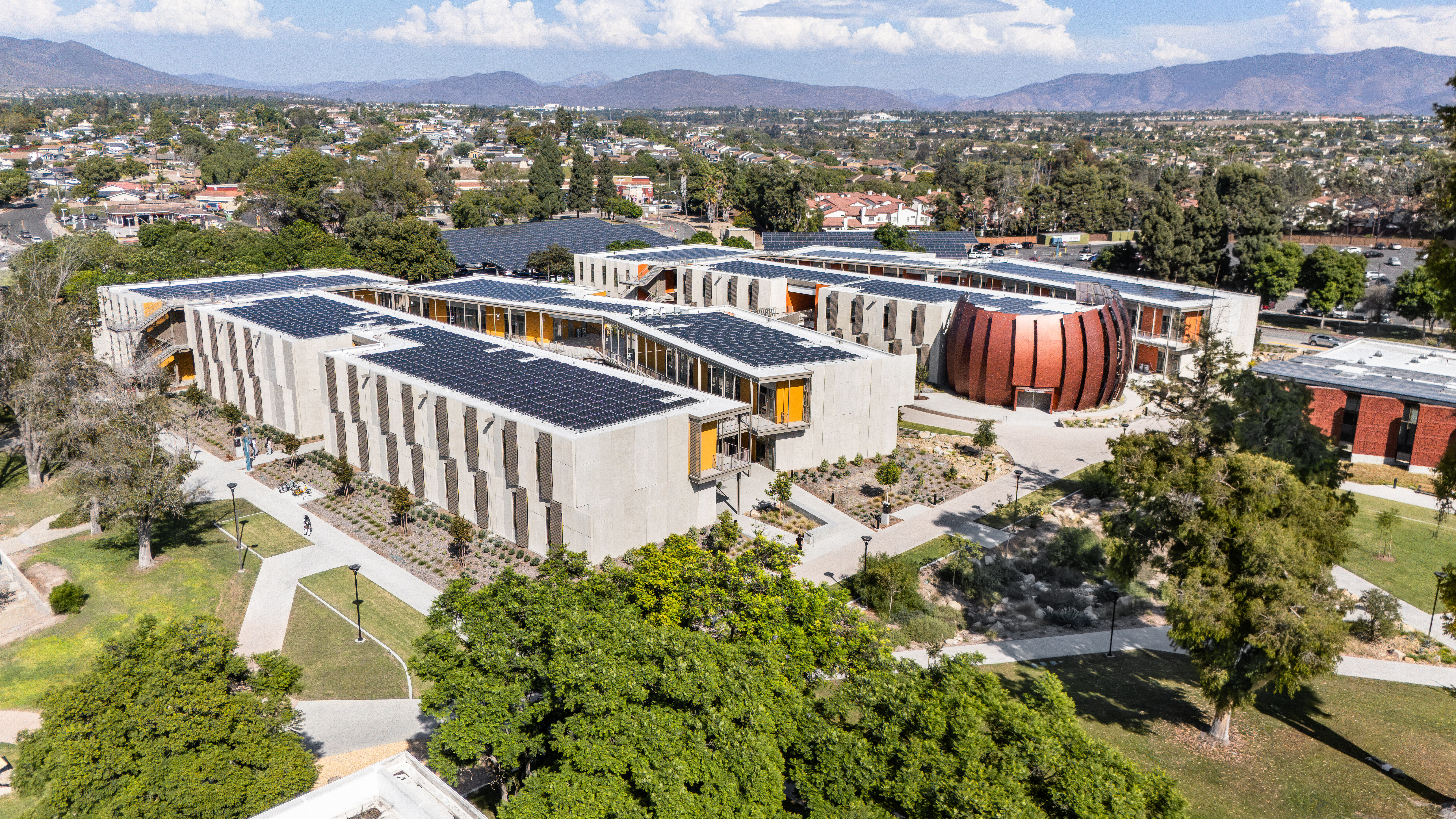
Southwestern Community College District’s vision went beyond constructing new classroom buildings to creating a shared campus hub where students and faculty could connect, collaborate, and discover new ideas. Today, the Instructional & Discovery Complex (IDC) sits at the heart of the Southwestern College campus in Chula Vista, California, bringing that vision to life.
Rudolph and Sletten delivered the 114,000-square-foot complex in partnership with Southwestern Community College District, Gafcon, and Gensler. The project includes ten two-story concrete tilt-up buildings arranged around landscaped courtyards and connected by outdoor walkways and bridges. The layout creates a series of open gathering spaces that help tie the campus together while encouraging interaction between departments and students.
The University Center is dedicated space where additional partner colleges will offer four-year bachelor’s degree programs for institutions such as San Diego State University, Arizona State University, Point Loma Nazarene University, CSU San Marcos, and UC San Diego. Inside the buildings are 40 instructional spaces, faculty offices, and a University Center that supports multiple academic programs. The complex serves the Schools of Arts, Communication and Social Sciences, Business Technology, and Language, Literature and Humanities, and is expected to support approximately 6,800 students each year. While the square footage and numbers are impressive, the real goal of the project was to create a place that feels connected and welcoming, a place where learning extends beyond the classroom walls.
Building in the Middle of Campus Life
The construction of the IDC involved careful planning that began long before any concrete was placed. The project site sits right in the center of an active college campus, surrounded by existing buildings, pedestrian walkways, and the campus loop road. Students and faculty were moving through the area every day, so the construction team had to be thoughtful about how work was sequenced and how disruptions were minimized.
Limited space made logistics one of the biggest challenges. With ten buildings going up at once, there was very little room for staging materials or equipment. The team worked through detailed planning sessions to determine how each phase of construction would move across the site.
Tilt-up concrete construction was used across all ten buildings, which meant coordinating large panel pours, crane operations, and structural work within a tight footprint. In total, the project incorporated more than 5,500 cubic yards of structural concrete and 142 tilt-up panels. Many of the panels feature architectural finishes such as sandblast textures, striated patterns, and detailed reveals that add character to the buildings.
Because space was limited, casting slabs were distributed throughout the site so panels could be poured and lifted efficiently. Each slab was reused multiple times, which required tight coordination between the crews placing concrete, the teams preparing panels for lifting, and the crews installing structural steel.
Under the leadership of Senior Superintendent Jerry Presley, the field team developed a sequencing plan that mapped out crane locations, panel casting areas, and erection schedules across the entire site. That level of planning helped keep construction moving smoothly even with the tight logistics.
Panel erection presented its own challenges. The 300-ton crawler crane used to lift the panels had to be assembled in a nearby parking lot before being carefully moved across the campus loop road and into position on the jobsite. Protective measures were put in place to protect existing pavement and underground utilities while the crane was maneuvered into place.
A Planetarium That Anchors the Complex
One of the most recognizable elements of the Instructional & Discovery Complex is the new planetarium. Designed to serve as both an educational resource and a visual centerpiece for the campus, the structure immediately stands out as visitors approach the complex.
The exterior is wrapped in curved perforated aluminum panels that rise between 33 and 39 feet high. The panels form a ten-sided geometric structure supported by a structural steel frame anchored to a tilt-up concrete core.
Inside the planetarium is a 34-foot aluminum projection dome that rises about 25 feet above the floor. The dome is supported by a system of aluminum ribs and compression rings designed to maintain the precise geometry required for projection accuracy.
Advanced projection and sound systems allow the space to host immersive astronomy programs and educational presentations. Lighting systems inside and outside the building add another layer of experience. Programmable interior lighting helps create a fully immersive environment for presentations, while exterior lighting highlights the perforated panels at night, making the planetarium a focal point of the campus after dark.
Solving Challenges Below the Surface
Like many projects on an existing campus, some of the biggest challenges were underground.
During demolition, the team discovered that a major 12-kilovolt electrical system ran directly through the footprint of the new buildings. Working closely with campus electricians and consultants, the project team developed a plan to reroute the system while maintaining power to nearby facilities.
Natural gas infrastructure also needed to be relocated. By studying existing records and verifying field conditions, the team created a new routing plan that allowed construction to continue without interrupting campus services.
Another unexpected hurdle involved the campus IT data center. The facility needed to remain operational several weeks longer than originally planned. Rather than pause construction, the team adjusted the building sequence and shifted work to other parts of the project while the data center stayed active.
A Space Built for Discovery
Throughout construction, the project team stayed focused on collaboration and maintaining a strong relationship with the campus community. Faculty and staff were invited to tour the project during construction, giving them a chance to see how the complex was taking shape and how much coordination went into building it.
Today, the Instructional & Discovery Complex has become a new academic hub for Southwestern College. The courtyards and walkways create places for students to gather between classes, while the classrooms and shared spaces support a wide range of academic programs.
The planetarium adds something special, a place where science, curiosity, and discovery come together.
Projects like this are always about more than the buildings themselves. They’re about creating spaces that support learning and bring people together. With the IDC now open, Southwestern College has a new center of campus life that will serve students and the community for years to come.